

The Work Model You Are “Returning To” Never Existed
When two flexible work veterans discuss the costly illusion driving RTO mandates, AI failures, and talent shortages, plus the business case for getting flexible work right

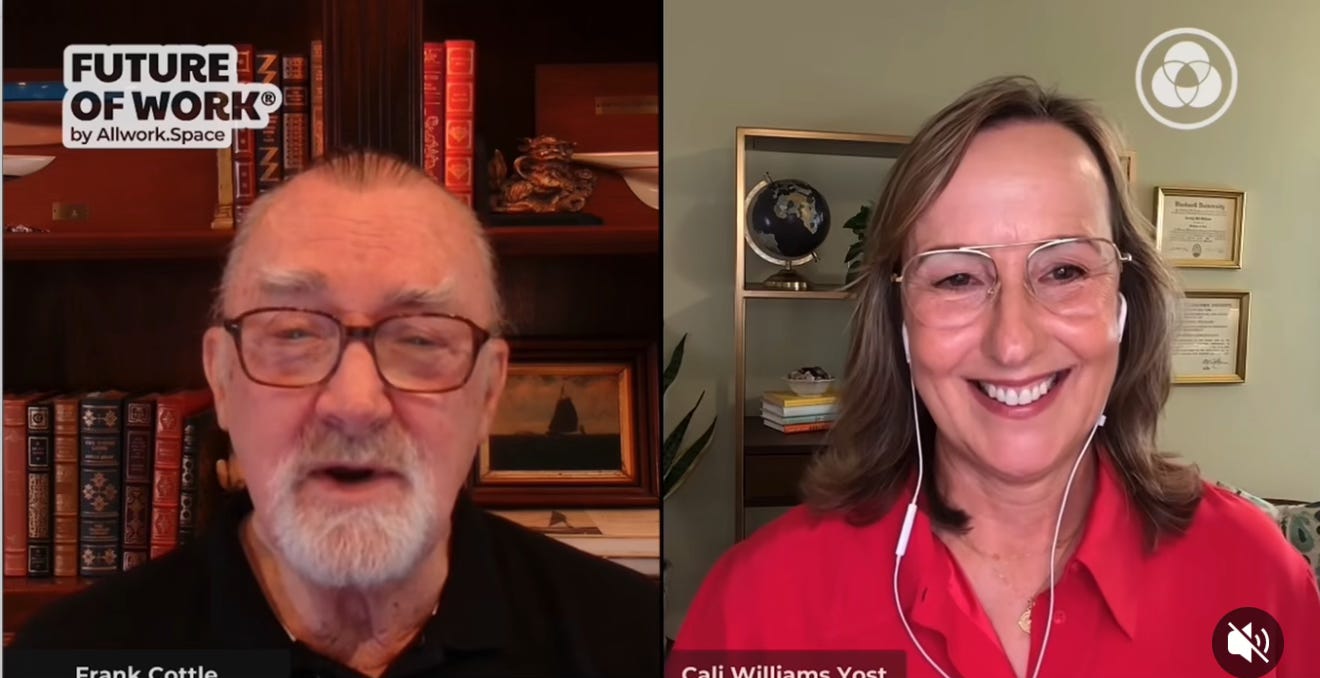
I recently joined Frank Cottle on the Future of Work podcast for a conversation between two veterans who've led the flexible work evolution for decades. Frank opened with the question every C-suite executive should be asking: “How do you get everyone in an organization on the same page about work?”
Before answering, I expanded it to include, “(And) How do we make flexible work models high performing?”
We talked about the role of managers and how, "Only 44% of managers are getting any training at all globally, according to Gallup. So, when you're leading a flexible work team, you need those skills. They don't have them."
Let that sink in. We've invested $62 billion in Gen AI over the past year—with McKinsey research showing 80% getting no return on investment. MIT found 95% of AI experiments are failing. Meanwhile, we're not investing in the basic competencies managers need to lead teams across different locations and times.
We're Solving for the Wrong Problem
We talked about how workspace utilization was less than 60% (JLL) before March 2020, "We were not at full (office) capacity before COVID at all." The traditional office model we're desperately trying to "return" to? It never existed the way leadership remembers it.
What I'm seeing is organizations "grasping, trying to get back to this traditional work model that they believe existed before COVID and it didn't. And that's holding us up from stepping forward."
The data show that organizations mandating five days in the office are getting three to four days of actual attendance. When they mandate two to three days, they're getting two. People don't know why they're there. No one took the time to build a shared understanding for what matters and will be prioritized in person and what you're going to do when you're not.
The Hidden Cost of Short-Term Thinking
"I would contend that we just need to take a step back and look at the bigger picture of work. Where it's happening, when it's happening, and how it's happening around AI and collectively train employees and involve them in the process."
But here's what's actually occurring. We're eliminating entry-level positions and reducing the number of managers available to train fewer new hires to pay for today’s technology investments. This puts the development of tomorrow's domain expertise at risk because, “You're eating your seed corn." Without that domain expertise, who's going to optimize the AI? Who's going to have the institutional knowledge to guide strategic decisions?
The Demographic Reality Check
During our conversation, I referenced Derek Thompson's recent article, “The US Population Could Shrink in 2025, For the First Time Ever,” and the Lightcast’s "Rising Storm" report documenting industry-specific labor shortages. As I quoted from Lightcast, there's a fundamental shift in mindset that has to happen: "Leaders who came into the workforce in the 70s and 80s need to understand that's not the workforce anymore. There is not this endless supply of talent that you can just draw upon as needed."
Next year marks when the US will have more deaths than births, while postings for jobs with flexible or remote options have more than a two-to-one response rate advantage. Organizations are fighting to get people back to an office model that never fully existed while ignoring the demographic shifts and what the workers want.
I also clarified a persistent myth: "I always love these studies that say women prefer flexibility. And then you look to see it's like a 3% difference between men and women...Guys want it too." All five generations in the workplace want flexibility: Baby Boomers with institutional knowledge who don't want to commute five days, mid-career professionals managing caregiving for children and parents, younger workers who intuitively understand distributed work but need and want in-person mentorship.
The Framework That Actually Works
I shared the model I've seen work best: "First and foremost, you have to have a senior business line leader sponsor it. It has to be somebody everybody respects because that's the only way that any kind of holistic rethinking of the work model is going to get the time, the money and the space to be done correctly."
Not HR alone. Not IT alone. A respected business leader who will hold the space and provide resources. Then you need cross-functional ownership: "They have to come together and say, what piece of this do we have to lead? What piece do you have to lead?"
"How do we reimagine the way work is done so that we can use that flexibility to fuel performance, engagement, innovation? Part of that, or the main part of that is getting everybody on the same page about where, when and how work is done."
The process follows a natural progression:
· Assess where you are now: what's working, what isn't.
· Align around a shared vision: "you can't have everybody evolving in their own different way."
· Activate through training and experimentation, making sure managers know how to lead and employees understand their roles and responsibilities.
I shared specific examples of the magic that can result when you bring generations together intentionally:
· Senior leaders explaining to younger employees why "it really matters for you to sit in a room with me and watch me communicate with a client."
· Younger employees teaching senior leaders how to use communication and collaboration technology,"because this is where a lot of our conversations are happening."
What You Can Do Right Now
Here's are actions you can take this week to start moving in the right direction:
Run a Reality Audit: Pull your actual office occupancy and utilization data from 2019. The actual badge swipe or occupancy sensor data. Then pull your current data. Share both numbers with your leadership team. Start the conversation from reality, not assumptions.
Map Your Silos: List every initiative touching how, when, or where work gets done: your RTO policy, your AI investments, your collaboration tools, your real estate strategy, your business continuity plan. Now identify who owns each. If they're not talking to each other weekly, you're wasting money and time.
Ask Your Managers One Question: "What training have you received in the last year on leading a team that works across different places, spaces and times?" If the answer is none, you've identified your first investment priority. It will deliver better returns than your next AI experiment.
The organizations that figure this out won't just survive the talent shortage. They'll have their pick of the best people, regardless of where they live. They'll actually get return on their technology investments because they'll have people who know how to use them.
It's time to come to terms with the fact that how, when, and where work is done will be flexible, and focus on making flexible work teams high performing. The alternative—endless mandates that don't work, technology investments that don't deliver, and talent walking out the door—is far more expensive than doing this right.
I'd love to hear where you're seeing progress, or what's holding you back?